



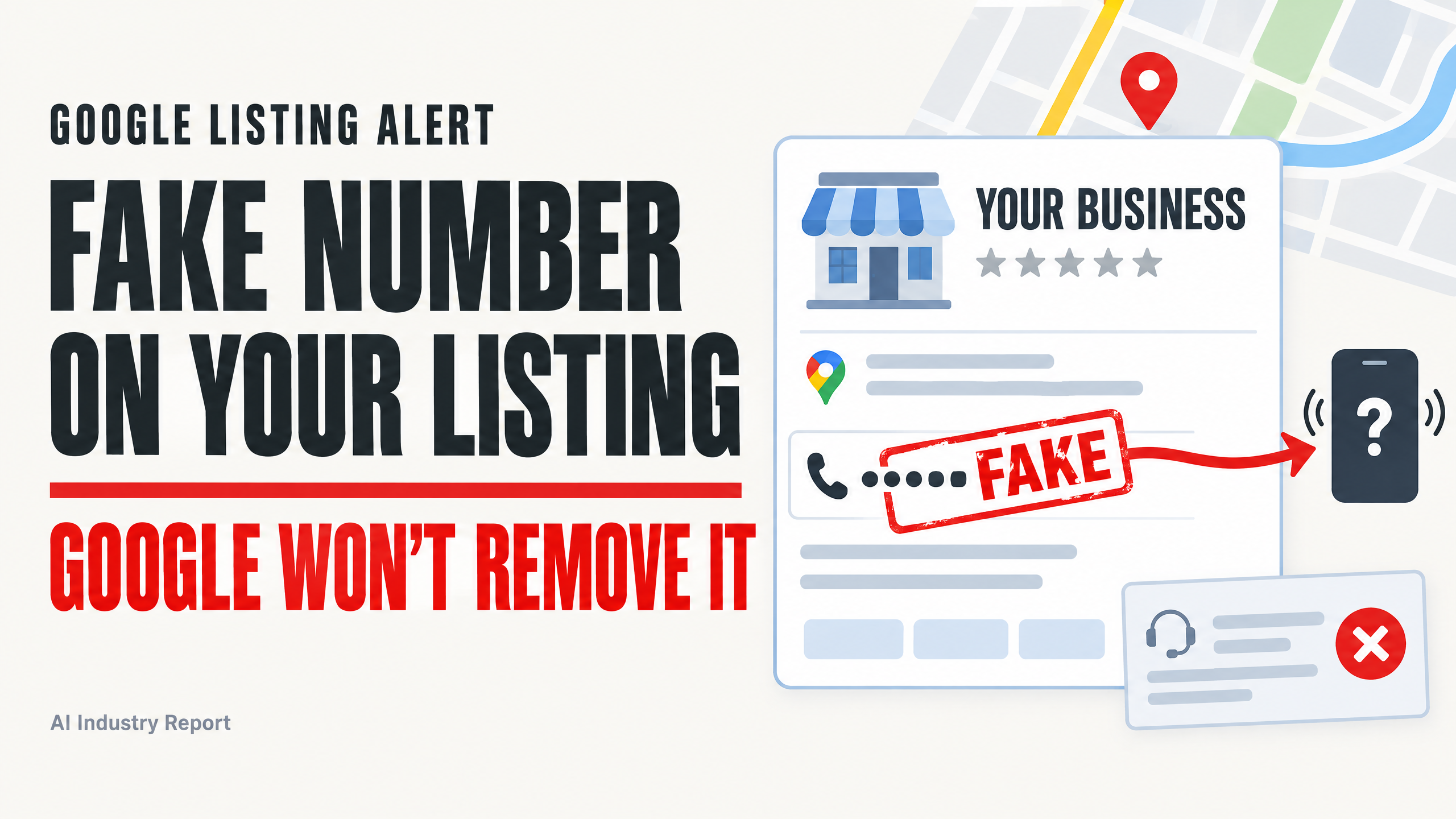
Four stories and one rumor, and the first one is a scam that puts somebody else’s phone number on your Google listing, inside a photo, where you’d never think to look.
▶ LISTEN TO THIS EPISODE
In this episode
- Scammers Are Uploading AI-Generated Photos With a Fake Phone Number Onto Google Business Profiles, and One Practitioner Says Her Reports Haven’t Gotten Them Removed.
- Meta Launched Muse, a Personal AI Agent With Its Own Browser That Fills Out Forms, Books, and Buys in the Background for Your Customers.
- 97% of Google’s “People Also Ask” Answers Are Now Written by AI, Up From 86% in August and About 12% Fourteen Months Ago.
- Apple Confirmed Apple Intelligence and Siri AI Will Carry Usage Limits, With Increased Access “Available for a Fee.”
- Rumor Watch: Meta’s Muse App Contains an Unreleased “Shared Agents” Section for Building Configurable Sub-Agents, Possibly Headed for Meta Connect.
Read the full transcript
Welcome to the AI Industry Report, daily AI news for small business, built by AI, about AI, from the Agentic Marketing Academy. It’s Thursday, September 10th. Four stories and one rumor, and the first one is a scam that puts somebody else’s phone number on your Google listing, inside a photo, where you’d never think to look. Let’s go.
Okay, the big one first, and it’s the kind you want to check before you finish your coffee. Anybody who uses Google Maps can upload a photo to any business listing. Yours included. And scammers have worked out that AI will generate a clean, believable image with your business name across it and a phone number that belongs to them. They upload it, and Google sometimes shows it big, right up top, where a customer reads it as your cover photo. So somebody looks you up, sees what looks like your sign, dials the number printed on it, and lands on a scammer. Naomi Stevens found one on a roofing client’s profile, then looked up the account that posted it: over a hundred and fifty photos, businesses all over the country, same fake number on every one. She reported it, wrote to Google support, and uploaded her own logo and cover photo trying to bury it. It’s still up. Nobody is coming to fix this one for you. So today, pull up your profile, tap into Photos, and look at every picture a customer sees. Anything you didn’t put there, report it. Source: Naomi Stevens and Sam Sarsten on LinkedIn, reported by Search Engine Roundtable, this morning.
Next up, and this one isn’t aimed at you. It’s aimed at your customer. Meta released an agent called Muse. Not a chatbot you type at — it has its own computer and its own web browser, and it keeps working while the app is closed. Meta’s own example: it watched a mom’s school emails, put the dates on the family calendar, filled a cart with supplies, and booked a dinner. It asks permission before it actually buys or sends. Everything before that, it does alone. So why does that land on you? Because the next thing that fills out your contact form may not be a human being. And an agent doesn’t look at your website, it reads it. If your prices live inside a photo, if your menu is a PDF, if your booking link falls apart on a phone, a person shrugs and works around it. An agent doesn’t shrug. It picks the business whose page it could actually use. Source: Meta’s own Muse announcement this week, and the AI at Meta account on September 8th.
Now here’s a number I’d sit with for a minute. You know those questions that fan out under Google results, People Also Ask? AlsoAsked went through 19.2 million of them from this year. In the first week of September, 97 percent of those answers were written by Google’s AI. In August it was 86. Fourteen months ago, 12. Another tool, Allintitle, says it already hit a hundred back in August. And remember what that box used to be. Google pulled a sentence off a real page, showed it, and linked back. Small sites won clicks in there they’d never win in the top ten. That door’s closed. Google writes the answer now. You can still be the source it learned from and the name it says out loud. The click just isn’t part of the deal anymore. Source: AlsoAsked’s Mark Williams-Cook and Allintitle’s Saeed Khosravi on LinkedIn, via Search Engine Roundtable, September 9th.
Quick one before we go, and it’s about your bill. Apple put up a support page yesterday explaining what happens to Apple Intelligence once everybody’s using it. Siri AI, the photo cleanup tools, Image Playground, the AI inside apps other developers build — all of it runs on Apple’s servers, and Apple says it’s going to cap how much you can use. Hit the cap, that feature goes dark for a while, then comes back. Then the sentence that matters: increased access to such features will be available for a fee. No price, no date. But if you touch up product shots on your phone between customers, budget for that becoming paid. Source: Apple’s own support document, published September 9th.
And the rumor watch. Back to Meta for a second. TestingCatalog went digging inside the Muse app and found a section that isn’t switched on yet, called Shared Agents, a working setup flow for building smaller, purpose-built agents inside your main one. Meta hasn’t announced it, and Meta Connect is coming up, which is exactly where they would. One outlet, one look under the hood, no company statement, so hold it loosely. But if it ships, your customer isn’t sending one general-purpose agent at you. They’re sending a specialist. A grocery one. A find-me-a-contractor one. Source: TestingCatalog, September 10th.
So here’s your one thing for today. Open your Google Business Profile on your phone, go to Photos, and scroll all of them the way a stranger looking for your number would. Report anything you didn’t upload, and make sure the picture at the top is one you put there.
That’s today’s report. Transcript and every source linked at A I industry report dot com.
If you want your business to be the one AI recommends, the free checklist at the leveling window dot com is where everybody starts.
And full transparency, because we practice what we teach: this show is researched, written, and voiced by AI, built by our founder. We teach businesses what AI can do. This show is the proof. Hit follow, and tomorrow’s report finds you on its own.
Sources
- Google Maps Phone Number in Photo Scam, via Search Engine Roundtable (the contributor with 150+ uploads, the failed reports, and the support response)
- Sam Sarsten on LinkedIn: scammer trying to redirect calls, with Naomi Stevens’ full account of the roofing client’s profile
- Meta: How We Designed Muse (its own computer, browser, transactions, proactive background work, and the approval cards)
- Meta introduces Muse as a proactive personal agent, via TestingCatalog (feature walkthrough and the AI at Meta announcement)
- Almost 100% Of People Also Ask Results Are Answered By Google AI Overviews, via Search Engine Roundtable (AlsoAsked’s 19.2M sample and Allintitle’s Also Ask Miner data)
- Apple Support: Learn about Apple Intelligence usage limits (the server-side feature list, the timeout behavior, and “increased access will be available for a fee”)
- Apple shares more details about Apple Intelligence usage limits and terms, via 9to5Mac
- Meta to announce Shared Agents for Muse at Meta Connect, via TestingCatalog (Rumor Watch)
Want your business to be the one AI recommends? The free Agentic Readiness Checklist walks you through the 15 signals AI agents check, in plain English. Get it at thelevelingwindow.com.
The AI Industry Report is researched, written, and voiced by AI, built by the founder of the Agentic Marketing Academy. We teach businesses what AI can do. This show is the proof.